

Tatiana Khodakova
“Your fears are not real. Most of the misfortunes I was so afraid of in life never came to pass” (Mark Twain)
I suggest you remember a well-known parable that illustrates the power of fear of the unknown.
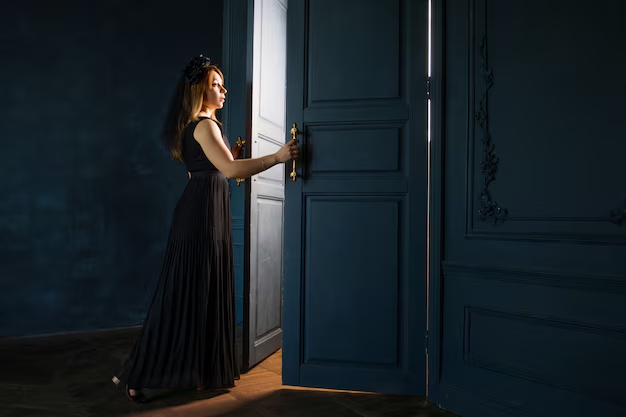
A man was brought to trial before the ruler. The case was complex, and the ruler offered him the choice of punishment: either prison or a large black door from which no one ever returned. The criminal thought for a moment and chose prison.

As he was leaving, he became curious. He asked the ruler: "What’s behind that door?"

The ruler smiled and answered: "Freedom. That’s why no one ever returns. Because people are so afraid of the unknown that they prefer prison".
This parable is a powerful metaphor for our lives. We often find ourselves in a similar situation where the familiar evil seems preferable to the potential good. When a person spends years living in a way they don’t want, working at a job they dislike, in unhappy relationships, or living in uncomfortable circumstances, they always find the same excuse: “I’m afraid of uncertainty”.
But what if this is a form of “flirting” with oneself? In reality, we aren’t afraid of uncertainty per se. We fear something very specific, even if we don’t realize it. We fear the repetition of negative experiences that we have faced ourselves or witnessed in others. We fear disappointment, poverty, loneliness, ridicule, shame, loss of control. These are very concrete fears that we give a general, convenient, and socially acceptable name to — “uncertainty”. Behind this word, we hide our true, but understandable, fears.
And a person, afraid to enter an unfamiliar door, probably painted in his mind not just uncertainty but something much more frightening than prison. After all, prison is a known, tangible evil. It is our unfavorite partner, boring work, an uncomfortable city. It represents discomfort, but discomfort that is specific and predictable. We know the rules of this game. We know how to survive in it.
But behind the door we are afraid to step through, there are no rules. There, our mind is given complete freedom and “freely” chooses to paint the worst possible picture. A person fears not freedom, but his own imagination of what might happen. He pictures not just change but total collapse: loss of everything, loneliness, poverty. He fears not uncertainty, but the monster that his very own fear has conjured in his imagination.
That is why we so often choose the known evil. We prefer the bird in hand — even if it pecks at us incessantly — because we cannot even imagine what awaits us in freedom. We choose prison to avoid confronting what we think lies behind the door. The irony is that the scariest thing there is our own illusion.
So, under the “sauce” of uncertainty, our mind sells us a familiar horror story, and we obediently buy it. But if we strip away all the painted pictures, one logical question arises: “Why should there be something bad behind uncertainty?”
The answer lies not in logic but in biology. It’s a side effect of our evolution. Our brain is not a factory for producing happiness but a complex survival system. Its primary task is to ensure our safety, not to make us happy. Uncertainty represents a potential threat to it, not an opportunity. The predictable swamp we sit in will always seem safer than the unknown shore, where, as we think, predators might be lurking. Our biology gives us no other choice. It screams: “Don’t take risks! Stay where you are! Survival is paramount, while happiness and joy are merely optional conditions”.
That is why we do not seek freedom, but desperately cling to our prison. Our mind constantly looks for familiar patterns to reduce energy expenditure and minimize risks. It convinces us that “the best is the enemy of the familiar”. We choose the unhappiness we can control (at least we think we are in control) over the happiness that seems unpredictable.
Here, our survival instinct, though useful, misses something fundamental. It overlooks the knowledge that quantum physics experimentally confirms.
This is about the principle of uncertainty, which states that it is impossible to simultaneously and precisely measure the speed and position of a particle. The world at this level is inherently unpredictable. A particle does not exist in a single point but is in a state of superposition — it is as if it is “smeared” across space, potentially existing in several places at once. Only at the moment of observation does it “choose” one specific state.
This knowledge is key to understanding our freedom. When we fear uncertainty, our mind tries to “measure” and “fix” all parameters of the future, to create one single, predictable scenario. However, by allowing for uncertainty, we permit not one, but many potential outcomes. We allow a whole spectrum of possibilities to unfold, which our limited experience could not even conceive.
Our brain, in trying to protect us, fixes the “particle” of our life in one familiar point — in prison. But if we release this control and embrace uncertainty, we, like in the quantum world, will discover an entire array of potential “places” where our life can be. We will stop seeing only one predetermined reality and will see a whole world of possibilities waiting for our choice — a choice we make by focusing our attention.
In other words, when we reject uncertainty, we reject freedom itself. We give up the variety of possible outcomes and get stuck in a single scenario — the one we are used to living, even if it does not satisfy us.
What is most sad is that we constantly multiply this option, feeding it with our focus and attention. Every time we complain about our job but don’t look for a new one, every time we think about ending a relationship but don’t take a step, we make this “prison” even more real. It’s as if we are telling the Universe: “No, I am not ready for something new. I choose this because it is familiar”. And our own fear becomes the force that keeps us from stepping through the door to freedom.
We close this door ourselves, convincing ourselves that what lies beyond is not freedom, but something much worse than what we have now. Thus, we voluntarily give up our quantum potential, the possibility of being in several places at once, to choose that which is happiest for us.
ACCEPTING UNCERTAINTY — GAINING FREEDOM
So, if we learn to see uncertainty not as a threat but as a wealth of options, we can stop striving for illusory control. Instead, we can learn to trust the very process of life, which often leads us to much better outcomes and solutions than we could ever imagine. Our fear always paints a single path — bad, but familiar. But reality, like a quantum particle, exists in superposition — it holds thousands of possibilities, and each one can be a door to freedom.
Rejecting uncertainty means consciously flattening the entire richness and variety of life down to one familiar script, even if it is unsatisfactory. It is like closing our eyes to a vast, infinite universe and convincing ourselves that we exist only in a single room.
By accepting uncertainty, we do not lose control; rather, we gain it on a qualitatively new level. It is the understanding that the best way to manage our lives is not to try to predict them but to trust in their uncertainty. It is the choice of a door behind which, as in a parable, lies freedom. It is a choice that we can finally make.
We can continue to cling to our prison — a familiar yet unhappy one. Or we can take a step into the unknown. After all, history shows that those who dared to enter the black door never returned. Because they found freedom.
“Do not seek safety. Live in uncertainty. This is the only way to grow” (Osho)
Photo freepik
Translated by Maria Zayats
Read also:
The best version of yourself: Exiting the race of improvements
Antidote to Helplessness. How to speak to yourself and the world to escape the victim role

Татьяна Ходакова
Практический психолог
Интегративный подход